
Era vs. Moment
We’re not in a moment to meet. We’re in an era.

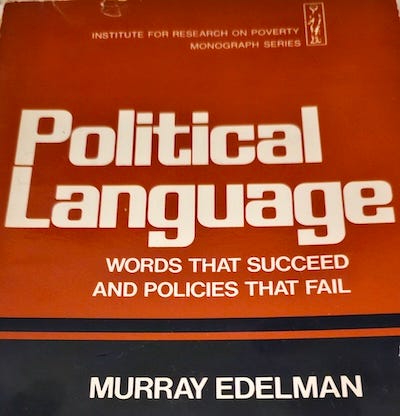
Early in my political and policy communications career, I was introduced to Murray Edelman’s Political Language: Words That Succeed and Policies That Fail. Edelman examines how language shapes policies and actions related to poverty and inequality—how the words we use determine what becomes possible and what remains out of reach. I periodically revisit the book as a reminder that language, indeed, matters. Not just for clarity, but because it dictates how we respond to what’s in front of us.
Right now, the language we’re using is failing us.
Everywhere I turn, I hear people talking about “meeting the moment”—as if what we’re experiencing is a discrete event, a challenge to rise to, a crisis to manage. But we’re not in a moment. We’re in an era. And the distinction matters more than most people realize.
A moment is a point in time. It’s typically a catastrophic event—a natural disaster, a market crash, a single rupture in the social fabric. Moments can be treated as aberrations. They allow for temporary responses with the expectation that things will eventually return to normal. The old rules still apply; we just need to weather the storm.
An era is something else entirely. It’s a protracted period marked by convergence—multiple forces colliding and reshaping reality simultaneously. We are in an era defined by ceaseless, unrestrained brutality lodged against human beings and communities; intense, simultaneous transformation in our economy, political system, and rapidly moving technology. This isn’t one thing going wrong, one crisis to get through. It’s the ground shifting or collapsing beneath our feet.
The difference between a moment and an era is the difference between a temporary crisis and a permanent shift in reality.
When we mischaracterize what’s happening as “a moment to meet,” we do a disservice to human beings, communities, and society. We treat widespread, systemic transformation as if it were a temporary situation. We reach for old playbooks expecting them to work. We wait for things to go back to normal. We think an election cycle will reverse course. And in doing so, we paralyze ourselves.
A moment requires a short-term response. An era requires both short-term triage and long-term reimagining. It demands that we recognize the old rules no longer apply—that we’re building something new, whether we’re intentional about it or not.
In my lifetime, I have not seen or experienced anything like this protracted period of crises, rapid speed of destruction, and pounding, unceasing acts of depravity on human life coming at us all at once. I’ve had to rethink and adjust how I show up in my personal life, my community, and professionally. What is required of me? What is required of all of us?
The first step is calling it what it is: an era happening in real time.
Next, we’ll need to talk about what leadership looks like when the old playbook no longer works.
This is such a critical point. We keep talking about “meeting the moment.” But this is not about a "moment." This is the dawn of a new era.